What About Baptism? A Friendly Reply to Pastor Aldridge
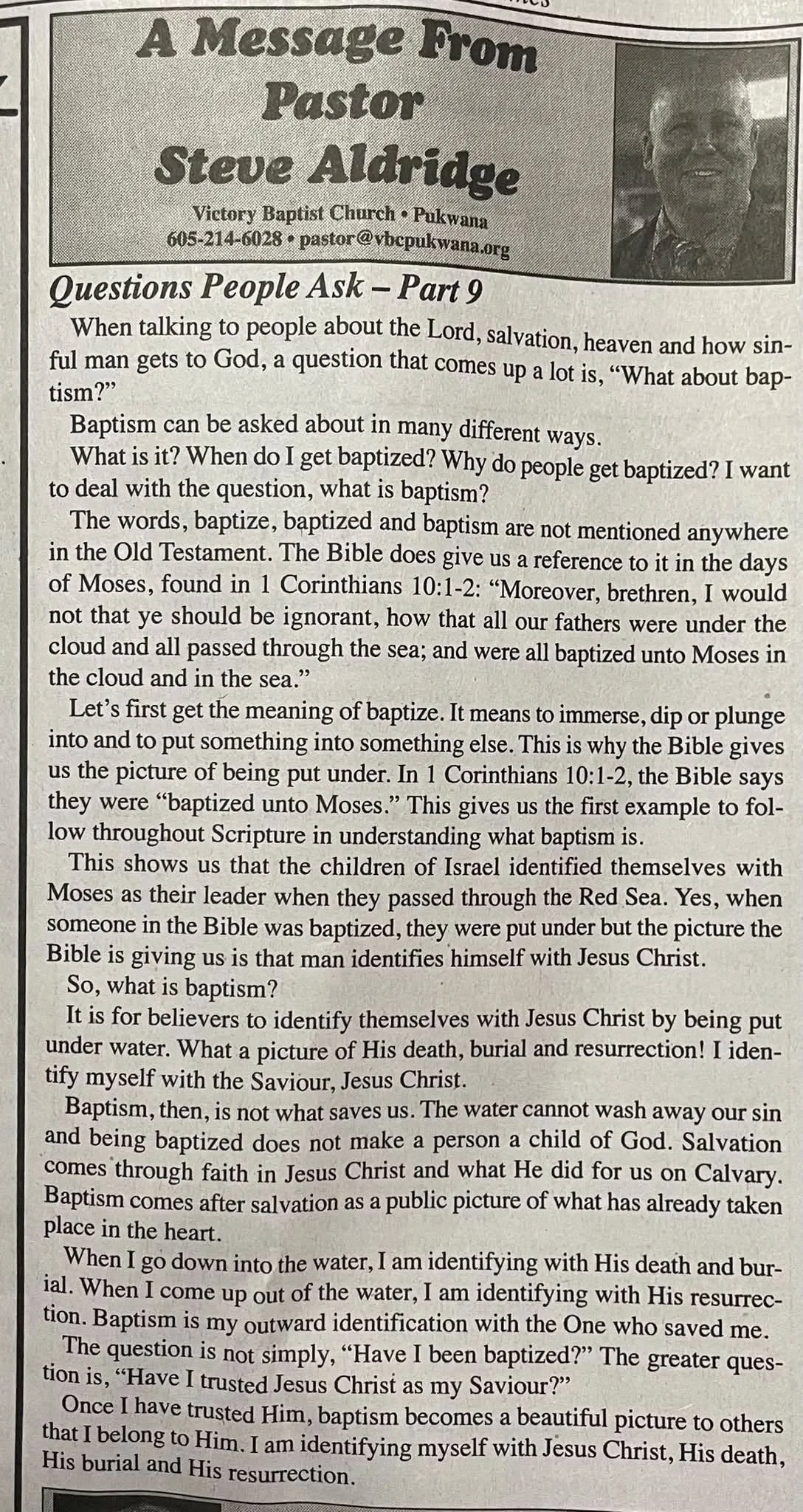
I read Pastor Steve Aldridge's recent column, "Questions People Ask – Part 9," (you can read his column below) with genuine appreciation. He is right that salvation comes through faith in Jesus Christ and His finished work on Calvary. He is also right to tie baptism to our Lord's death, burial, and resurrection. Because "What about baptism?" matters so much, I'd like to offer a Lutheran response. I offer it as a brother in Christ who believes Scripture says more about baptism, not less.
The heart of our disagreement is simple. Pastor Aldridge presents baptism as something the believer does for God. Lutherans, reading the same Bible, see baptism as something God does for us. Nearly everything else follows from that difference.
First, Scripture says baptism saves. The column states, "Baptism, then, is not what saves us." Yet St. Peter writes: "Baptism, which corresponds to this, now saves you, not as a removal of dirt from the body but as an appeal to God for a good conscience, through the resurrection of Jesus Christ" (1 Peter 3:21). Peter anticipates the objection that baptism is only water. He says its saving power is not in the water's physical washing but in the risen Christ. Jesus Himself says, "Whoever believes and is baptized will be saved" (Mark 16:16). Paul writes that God "saved us, not because of works done by us in righteousness, but according to his own mercy, by the washing of regeneration and renewal of the Holy Spirit" (Titus 3:5). Notice that Paul sets baptism opposite to our works, not alongside them. Baptism is God's mercy in action.
Second, baptism forgives sins. Plain water cannot wash away sin; on that we agree. But baptism is never plain water. It is water joined to God's command and promise, and the promise is what makes it powerful. On Pentecost, Peter preached, "Repent and be baptized every one of you in the name of Jesus Christ for the forgiveness of your sins" (Acts 2:38). Saul of Tarsus had already met the risen Lord and prayed for three days. Even so, Ananias told him, "Rise and be baptized and wash away your sins, calling on his name" (Acts 22:16). Ananias did not treat baptism as a picture of something already finished. He treated it as the place where God would wash Saul clean.
Third, baptism makes us God's children. The column says baptism "does not make a person a child of God." Paul joins the two together: "For in Christ Jesus you are all sons of God, through faith. For as many of you as were baptized into Christ have put on Christ" (Galatians 3:26–27). To "put on Christ" is to be clothed in His righteousness. Jesus taught Nicodemus that "unless one is born of water and the Spirit, he cannot enter the kingdom of God" (John 3:5). New birth is something that happens to us, not something we do.
Fourth, baptism is a real union with Christ, not a reenactment. The column's image of going down and coming up comes from Romans 6. But Paul does not say we pictured our burial. He says, "We were buried therefore with him by baptism into death" (Romans 6:4). We were "raised with him through faith in the powerful working of God" (Colossians 2:12). The verbs are passive, and the power belongs to God. Baptism does not dramatize our union with Christ. It creates that union.
Fifth, faith and baptism are not rivals. The column asks whether the greater question is "Have I trusted Jesus Christ as my Saviour?" Lutherans gladly confess that faith is necessary. Mark 16:16 warns that "whoever does not believe will be condemned," and a baptized person who rejects Christ forfeits the gift. But faith receives what baptism gives, and Colossians 2:12 holds them together. This is not trivial. It matters pastorally. When troubled consciences look inward to ask whether their faith is real enough, they find only weakness. Baptism points them outward, to a promise God attached to water in His own name. Luther's comfort in temptation was simple: "I am baptized into Christ."
Sixth, 1 Corinthians 10 points the other way. Israel was not "put under" at the Red Sea. They "went into the midst of the sea on dry ground, the waters being a wall to them on their right hand and on their left" (Exodus 14:22). It was the Egyptians who were immersed. And the crossing was God's act of deliverance through water, not Israel's act of identification. Peter draws the same connection from Noah, who was "brought safely through water" (1 Peter 3:20). Paul goes on to say Israel ate "spiritual food" and drank from "the spiritual Rock… and the Rock was Christ" (1 Corinthians 10:3–4). His warning about Israel's fall in the wilderness assumes these gifts were real.
Seventh, "baptize" does not strictly mean "immerse." The column says baptism is not mentioned in the Old Testament. Yet the Greek Old Testament (which Jesus and the apostles quote) uses the word for Naaman, who "dipped himself seven times in the Jordan, according to the word of the man of God, and his flesh was restored like the flesh of a little child, and he was clean" (2 Kings 5:14). Naaman also scorned the water as ordinary. What healed him was the water joined to God's word. In the New Testament, a Pharisee was astonished that Jesus "did not first wash before dinner" (Luke 11:38), and the word there is the same Greek word (baptizō) that is used throughout the New Testament for baptism. Mark 7:4 uses the same word for washing cups and pots. Immersion is a perfectly fine mode, but the mode is not the essence of the sacrament.
Eighth, the promise includes our children. Peter declared, "The promise is for you and for your children" (Acts 2:39). Lydia was baptized "and her household as well" (Acts 16:15). The jailer "was baptized at once, he and all his family" (Acts 16:33). When parents brought "even infants" to Jesus, He said, "To such belongs the kingdom of God" (Luke 18:15–16). And since we are sinful from conception (Psalm 51:5), our little ones need exactly what baptism gives. If baptism were our testimony, infants could not receive it. Because it is God's gift, they can.
Finally, the key question is who is acting in baptism. The column repeatedly says, "I identify," "I am identifying," and "my outward identification." But scripture places God at the center. Baptism is done "in the name of the Father and of the Son and of the Holy Spirit" (Matthew 28:19), that is, by His authority and as His deed. In baptism He saves, washes, regenerates, buries, raises, and clothes us with Christ. That makes baptism pure gospel. It is not our testimony to God but His gift to us.
I have a great deal of respect for Pastor Aldridge and an appreciation for his zeal to point people to Christ. My hope is simply that you will hear baptism as the good news Scripture proclaims it to be.
In Christ,
Pastor Nicholas Schultz