Baptism and the Baptism of Jesus: A Second Response
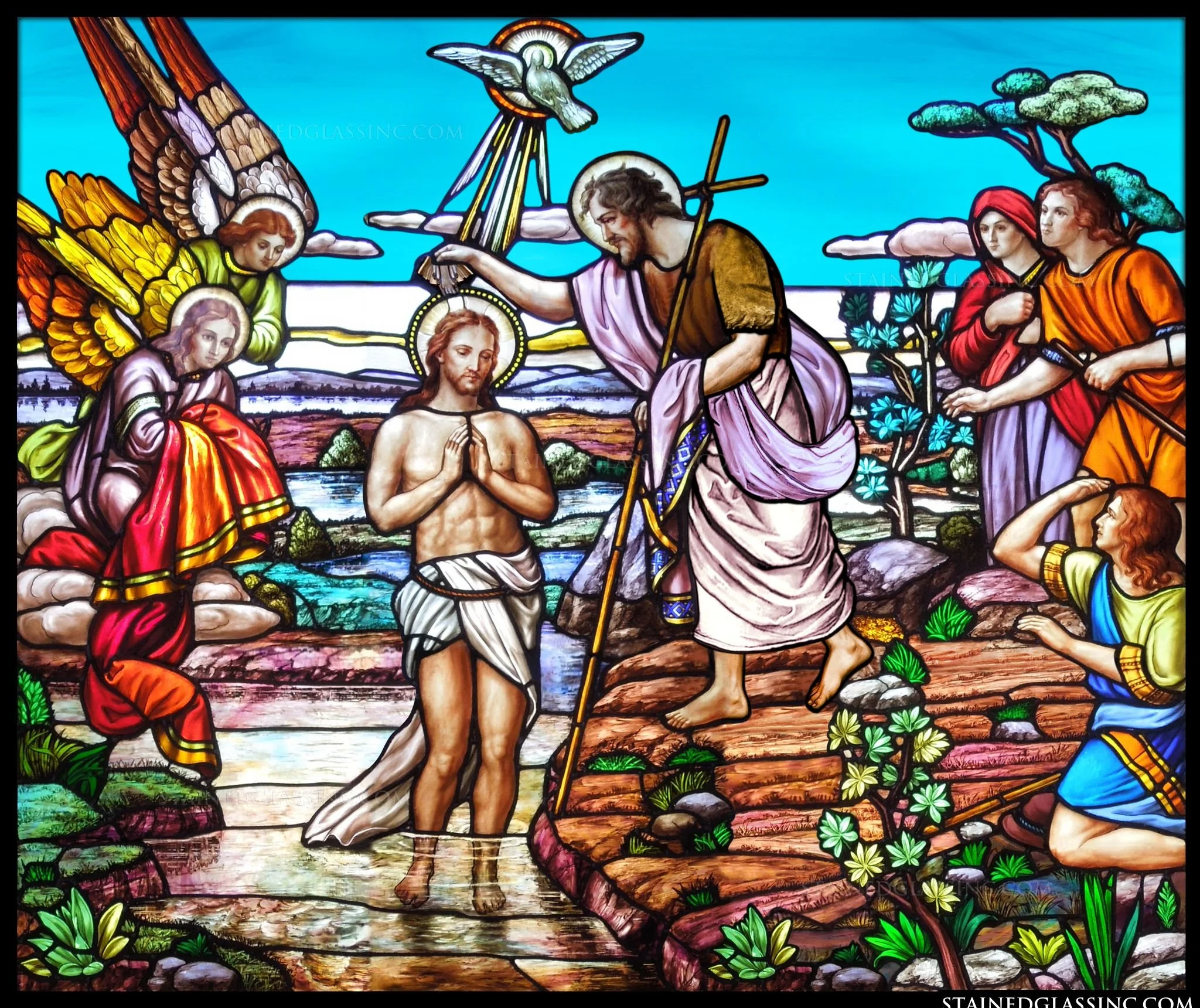
Stained Glass Image from: https://www.stainedglassinc.com/window/5431-the-baptism-of-jesus-by-john-the-baptist/
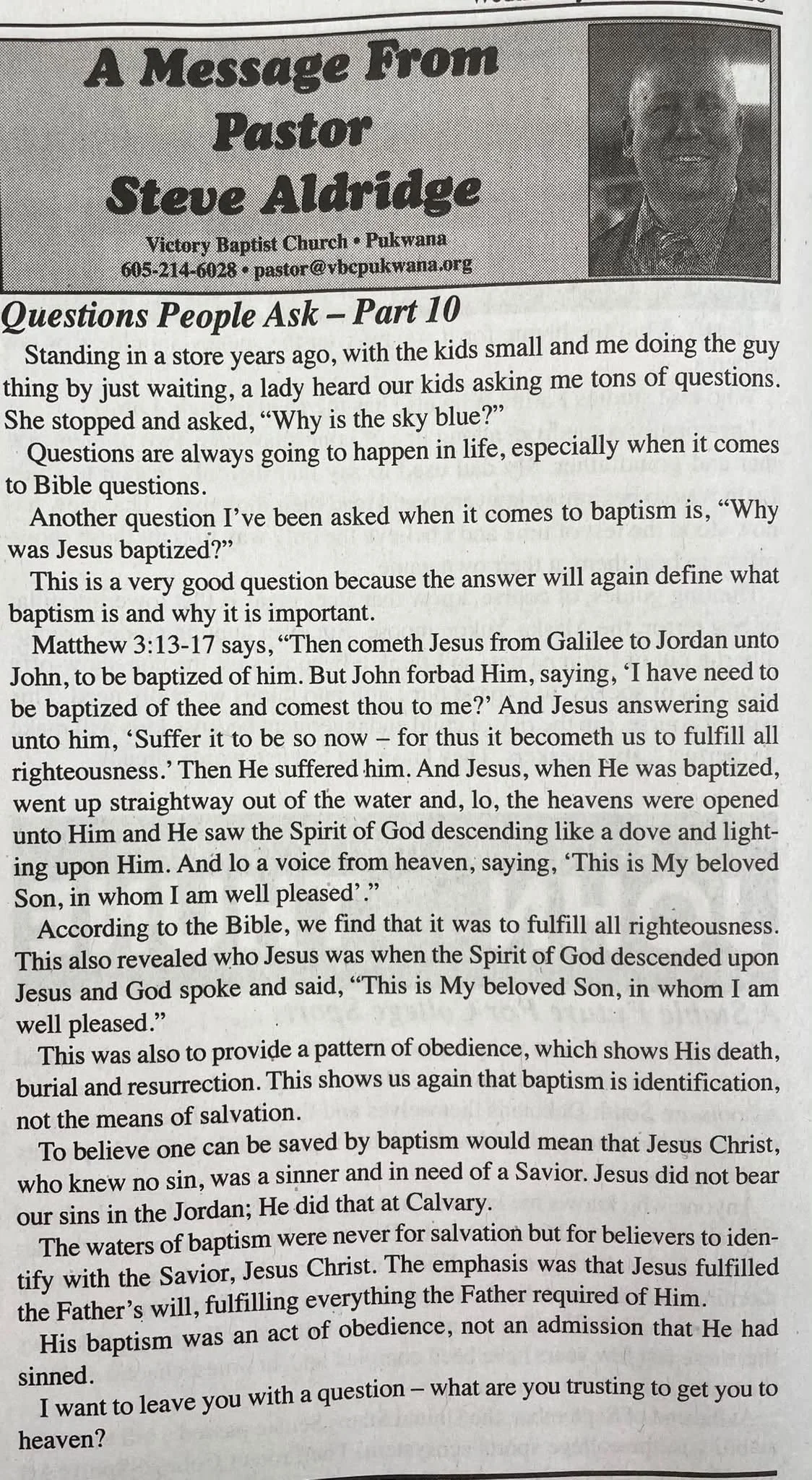
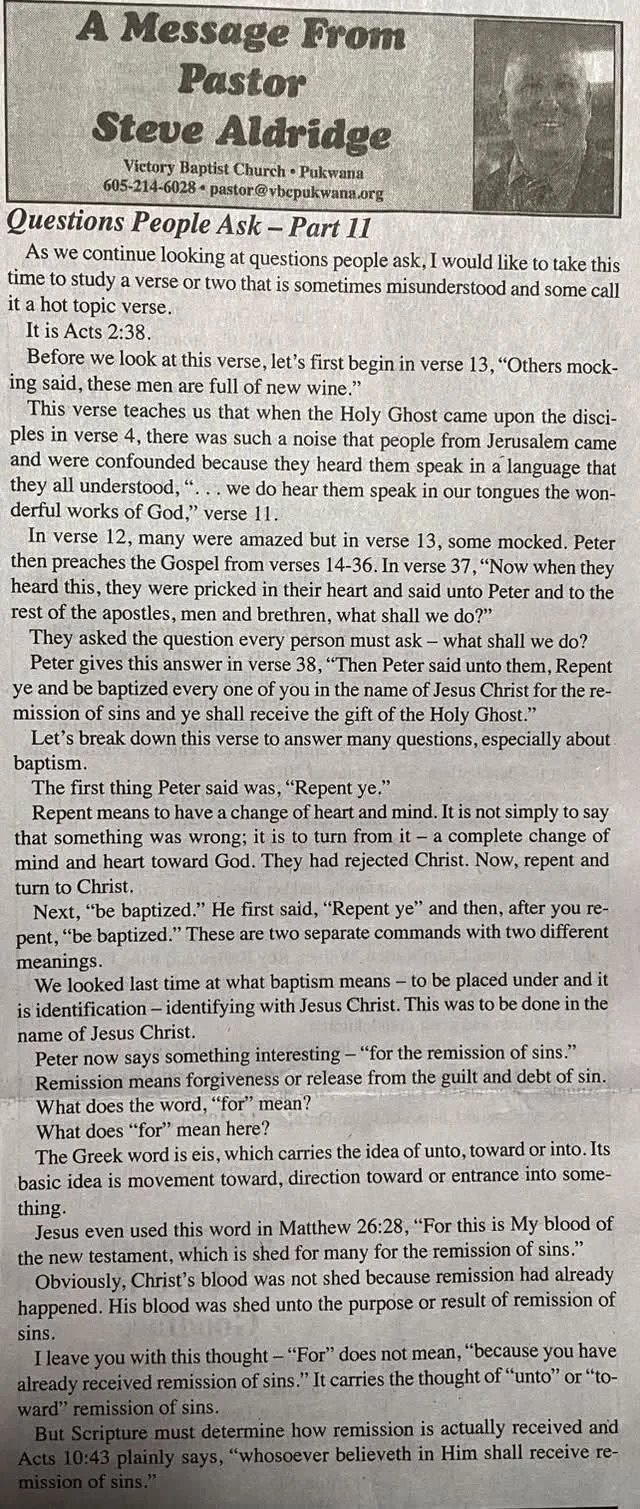
Pastor Steve Aldridge has continued his “Questions People Ask” series in the Central Dakota Times with two more columns on baptism (You can see the columns on the bottom of the page). Part 10 asks why Jesus was baptized, and Part 11 examines Acts 2:38. In my earlier response, “What About Baptism?”, I argued that the heart of our disagreement is who is acting in baptism. Pastor Aldridge presents baptism as something the believer does for God. Scripture presents it as something God does for us. These two columns bring that difference into sharper focus, so I offer a second response in the same spirit as the first, as a brother in Christ.
First, we agree that Jesus was sinless. Jesus was not baptized because He needed forgiveness. He bore our sins on the cross, not in the Jordan. And His baptism was an act of perfect obedience to His Father. On these points Pastor Aldridge and I stand together.
Second, the conclusion does not follow. Part 10 argues that if baptism saves, then Jesus must have been a sinner in need of a Savior. That would only be true if His baptism and ours were the same thing. They are not. Jesus came to John’s baptism “to fulfill all righteousness” (Matthew 3:15) by standing where sinners stand. Isaiah foretold that the Messiah would be “numbered with the transgressors” (Isaiah 53:12). The day after Jesus’ baptism, John pointed to Him and said, “Behold, the Lamb of God, who takes away the sin of the world!” (John 1:29). In the Jordan, the sinless One took His place among sinners and began the road that ends at Calvary, where God “made him to be sin who knew no sin, so that in him we might become the righteousness of God” (2 Corinthians 5:21).
Jesus’ baptism, then, is not mainly a pattern for us to copy. It is the public beginning of His work as our Substitute. Pastor Aldridge is right that Jesus’ baptism was obedience. But our baptism does not rest on our obedience. It rests on His. He fulfilled all righteousness so that we, who could never fulfill it, might receive it as a gift.
Christian baptism was instituted after His death and resurrection, when He sent His Church to baptize “in the name of the Father and of the Son and of the Holy Spirit” (Matthew 28:19). It is no accident that the whole Trinity was revealed at the Jordan. The same Father, Son, and Spirit present that day are named over every Christian at the font. What the Father declared over His Son, “This is my beloved Son,” He now declares over us as He adopts us in Christ. Calvary won forgiveness once for all. Baptism does not compete with the cross. It delivers the cross to us: “all of us who have been baptized into Christ Jesus were baptized into his death” (Romans 6:3).
Third, the early church read it this way. Pastor Aldridge’s question, “Why was Jesus baptized if He had no sin?”, is not new. Christians have been answering it since the first century, and their answer is worth hearing.
Ignatius of Antioch was a pastor who personally knew the apostles and was martyred around A.D. 110. He wrote that Christ was born and baptized so that by His suffering He might purify the water. Ambrose of Milan, the pastor who baptized Augustine of Hippo, put it even more plainly: the Lord was baptized not because He needed cleansing, but to cleanse the waters, so that, touched by the sinless flesh of Christ, they might have the power of baptism. Gregory of Nazianzus preached that when Jesus came up out of the Jordan, He carried the world up with Him. Luther stood in this same stream when he prayed, in his baptismal Flood Prayer, that God had sanctified and set apart the waters for a saving flood through the baptism of His beloved Son.
Notice that these teachers held both truths at once. Christ was sinless, and baptism saves. They did not see a contradiction, because they understood that Jesus entered the water for us, not for Himself.
The same church that answered that question also confessed baptism’s saving power. Justin Martyr, writing around A.D. 155, described new believers being brought to the water and “regenerated” there, just as the Christians before them had been. Tertullian, around A.D. 200, opened his treatise on baptism by rejoicing in the sacrament of water that washes away the sins of our former blindness and sets us free for eternal life. I know of no early Christian writer who taught that baptism was merely a symbol of salvation already received.
To be clear, Lutherans do not place the church fathers above Scripture. They are witnesses, not judges, and Scripture alone is the rule of faith. But when the church nearest to the apostles reads the apostles’ words plainly, we should take note. A symbolic view of baptism, by contrast, does not appear until the 1500s.
Fourth, “for” in Acts 2:38 means what Pastor Aldridge says it means. I appreciate his careful look at the Greek word eis, and I accept his definition: it points toward a purpose or a result. I also appreciate his definition of remission: forgiveness, or release from the guilt and debt of sin. That is a beautiful description, and it is exactly what Peter promises.
He rightly compares Matthew 26:28, where Jesus says His blood “is poured out for many for the forgiveness of sins.” As he says, Christ’s blood was not shed because forgiveness had already happened. It was shed to bring it about.
But that is exactly the point. Peter uses the same phrase: “Repent and be baptized every one of you in the name of Jesus Christ for the forgiveness of your sins, and you will receive the gift of the Holy Spirit” (Acts 2:38). If “for the forgiveness of sins” means Christ’s blood truly brings forgiveness, then the same words mean that baptism truly brings forgiveness. The grammar Pastor Aldridge presents supports the plain reading of the verse.
It is worth noticing where Jesus spoke those words in Matthew 26. He spoke them at the Last Supper, as He gave His disciples the cup. Even there, the Lord who would win forgiveness on the cross was already establishing a way to give that forgiveness to His people. Baptism and the Supper are not our works for God. They are the means by which Christ hands out what He won.
The church has always read Acts 2:38 this way. In A.D. 381, the Nicene Creed confessed, “I acknowledge one baptism for the remission of sins.” The Greek phrase in the Creed is the same phrase Peter used at Pentecost. Christians around the world still confess those words.
Fifth, two commands, one promise. Part 11 says that “repent” and “be baptized” are two separate commands with two different meanings. In one sense that is true: repentance and baptism are not the same thing. But Peter does not attach one promise to repentance and a different meaning to baptism. He attaches one promise to both: the forgiveness of sins and the gift of the Holy Spirit. He then explains whom that promise is for: “For the promise is for you and for your children and for all who are far off” (Acts 2:39). As I noted in my first response, a promise that includes our children is a gift God gives, not a testimony we make.
Notice also what happened next: “So those who received his word were baptized, and there were added that day about three thousand souls” (Acts 2:41). They did not wait to prove their sincerity first. They were baptized the same day, because they were receiving a gift, not making a declaration.
This also answers the concern in Part 9, which I addressed before, that “the water cannot wash away our sin.” Augustine famously wrote that when the Word is added to the element, it becomes a sacrament. Luther’s Small Catechism puts it this way: it is not the water that does such great things, “but the word of God which is in and with the water, and faith which trusts such word of God in the water.” We do not trust the water. We trust the One who attached His promise to it.
Sixth, Acts 10:43 does not set faith against baptism. Pastor Aldridge closes with Acts 10:43: “everyone who believes in him receives forgiveness of sins through his name.” Amen! As I wrote before, faith and baptism are not rivals. Faith receives what baptism gives.
Look at the whole verse: “To him all the prophets bear witness.” Among those prophets is Ezekiel, through whom God promised, “I will sprinkle clean water on you, and you shall be clean from all your uncleannesses... And I will put my Spirit within you” (Ezekiel 36:25, 27). Clean water, cleansing, and the Spirit are the same gifts Peter promised at Pentecost.
Then notice what happens a few verses later in the same chapter. Even after Cornelius and his household had heard the Word and received the Spirit, Peter did not treat baptism as optional or merely symbolic. He asked, “Can anyone withhold water for baptizing these people?” and “commanded them to be baptized in the name of Jesus Christ” (Acts 10:47–48). Scripture holds together what we are tempted to pull apart.
Seventh, baptism in the name of the Jesus does not mean, what some have said, “in the name of Jesus only.” This is a minor point, largely because Pastor Aldridge did not elaborate and so there is no claim by his writing or by me that this is his position. However, addressing this point addresses a common misunderstanding.
There are some who insist that baptism should be done in the name of “Jesus only.” These teachers point to Acts 2;38, Acts 8:16, Acts 10:48, Galatians 3:27, or Romans 6:3 to justify their position. These and other various texts will say baptized in the name of Jesus, into Christ, in the name of the Lord, and in the name of the Lord Jesus. The implication being, if you are baptized in the name of the Father and of the Son and of the Holy Spirit (Matthew 28:19) then you are doing it wrong.
In response, it is simple enough to say, “Well, if we are to be baptized in the baptism of Jesus, then what did he say?” The only answer is Matthew 28:19, baptism “in the name of the Father, and of the Son, and of the Holy Spirit.
Finally, consider what we trust. Pastor Aldridge ended Part 10 with a question every reader should ponder: “What are you trusting to get you to heaven?” My answer is Jesus Christ alone, crucified and risen for me. And because He is gracious, He does not leave me to search my own heart for proof that my faith or decision was sincere enough. He has given me a promise outside myself, spoken over me with water in His name. The same Jesus who stood in the Jordan for sinners now meets sinners at the font. When Luther was tempted to despair, he did not point to the strength of his commitment. He reminded himself, “I am baptized.” Baptism is not my pledge to God. It is God’s pledge to me, and that is a promise worth trusting.
Once again, I am grateful for Pastor Aldridge’s zeal to point people to Christ, and for a conversation that sends all of us back to the Scriptures.
In Christ,
Pastor Nicholas Schultz